
Understanding Cross Multiplication: The Complete Rule of Three Guide
Master cross multiplication with step-by-step mathematical explanations, visual fraction diagrams, and practical everyday examples.
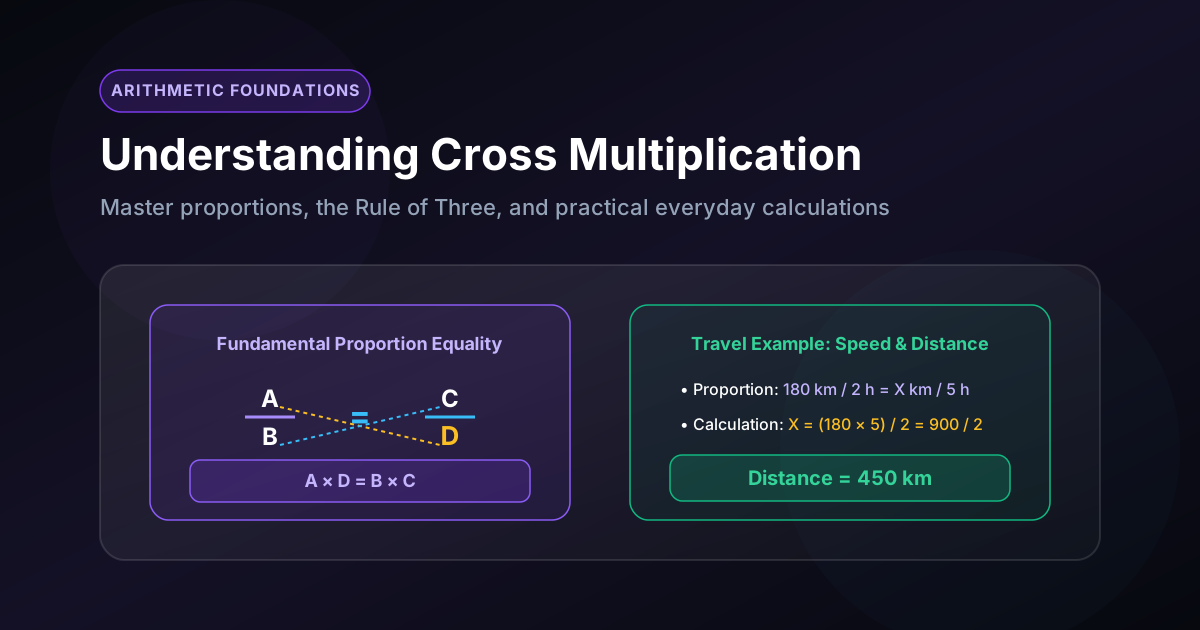
Cross multiplication—traditionally known in European mathematics as the Rule of Three (règle de trois in French, dreisatz in German)—is one of the most fundamental and universally practical tools in arithmetic.
Whether you are scaling a recipe, calculating currency conversions, resizing digital graphics, or converting engineering units, understanding how cross multiplication works empowers you to solve proportional problems instantly.
The Mathematical Foundation
At its core, cross multiplication is used to find an unknown value in an equality between two rational ratios (fractions):
A / B = C / D
When two fractions are equal, their diagonal cross-products are strictly equal:
A × D = B × C
Solving for Any Unknown Variable
Depending on which of the four variables is missing, you can isolate the unknown with simple algebraic division:
- If D is unknown: D = (B × C) / A
- If C is unknown: C = (A × D) / B
- If B is unknown: B = (A × D) / C
- If A is unknown: A = (B × C) / D
Practical Real-World Example: Travel and Speed
Suppose a vehicle travels 180 km in 2 hours. How far will it travel in 5 hours at the same constant speed?
- Set up the proportion: 180 km / 2 h = X km / 5 h
- Multiply diagonally: 180 × 5 = 900
- Divide by the remaining value: X = 900 / 2 = 450 km
The car will travel 450 kilometers in 5 hours.
Why Use an Online Cross Multiplication Calculator?
While the arithmetic is straightforward, manual calculations can introduce rounding errors, especially when working with non-integer decimals. Using an online interactive solver ensures:
- Instant accuracy: Sub-millisecond calculation with exact precision.
- Visual verification: Instant confirmation of numerator and denominator pairings.
- Step-by-step proof: Complete transparency for students and professionals.