
Finance · लेखक: Marc Dupont
Calculating Percentages with Cross Multiplication
Discover how to calculate sales tax, commercial markdowns, and percentage increases effortlessly with cross multiplication.
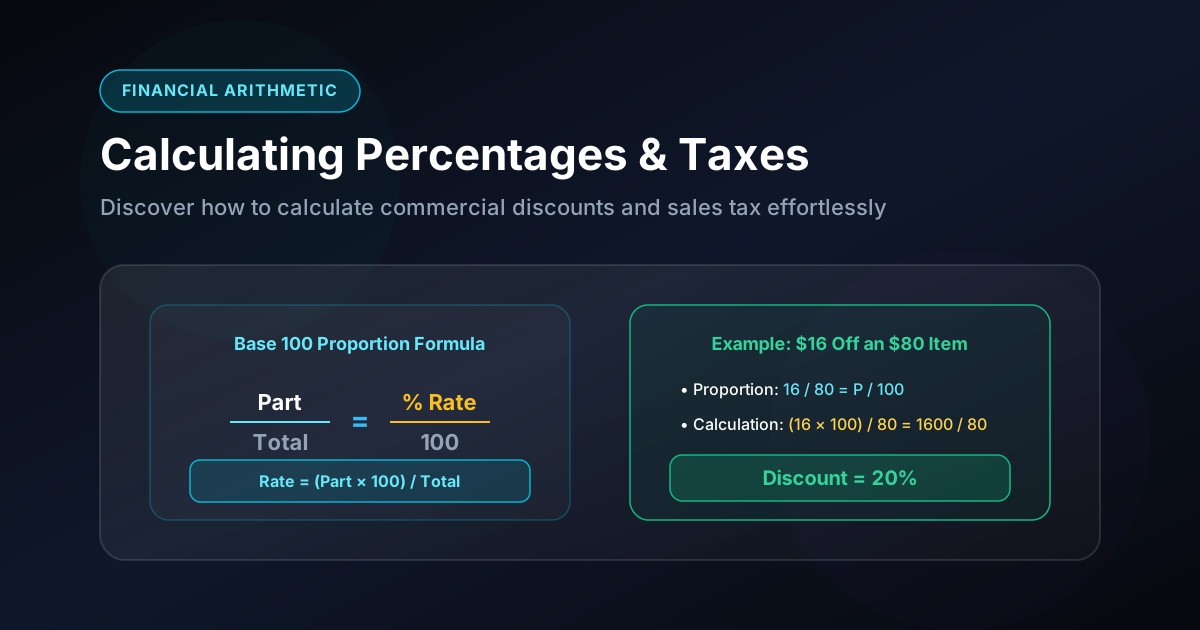
Percentages are simply ratios with a base denominator of 100. Because of this mathematical truth, any percentage calculation can be mapped seamlessly to a standard cross-multiplication proportion.
Setting Up Percentage Proportions
Part / Total = Percentage / 100
Example 1: Finding the Percentage of a Total
Suppose an item normally priced at 80 dollars is discounted by 16 dollars. What is the discount percentage?
- Set up the proportion: 16 / 80 = P / 100
- Cross multiply: P = (16 × 100) / 80 = 1600 / 80 = 20%
The discount is exactly 20%.
Example 2: Calculating Sales Tax and VAT
If a product costs 150 dollars before tax, and the local sales tax rate is 15%, what is the tax amount?
- Set up the proportion: Tax / 150 = 15 / 100
- Cross multiply: Tax = (150 × 15) / 100 = 2250 / 100 = 22.50 dollars
- Total price with tax: 150 + 22.50 = 172.50 dollars
Conclusion
Understanding how fractions and percentages connect through cross multiplication turns complex financial arithmetic into simple mental or digital equations.